Description:
In low-land areas, people need to protect themselves against high sea
water levels. To do so, on the one hand dunes are maintained at a
certain safety level and dikes are built. On the other hand, closing
off a complete coastline is not an option as rivers need to discharge
water to the sea and ships need to be able to navigate inland. For the City of
Rotterdam this has resulted in the construction of the Maeslant
Barrier, a unique structure in the world. When the barrier is open, no
obstruction for river flow and ships is present, while, during storm
at sea, the barrier can close off the port and city of Rotterdam
completly from influences from the sea.
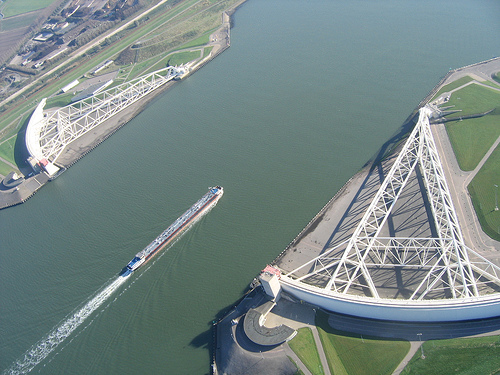
Fig. 1. Open Maeslant
Barrier
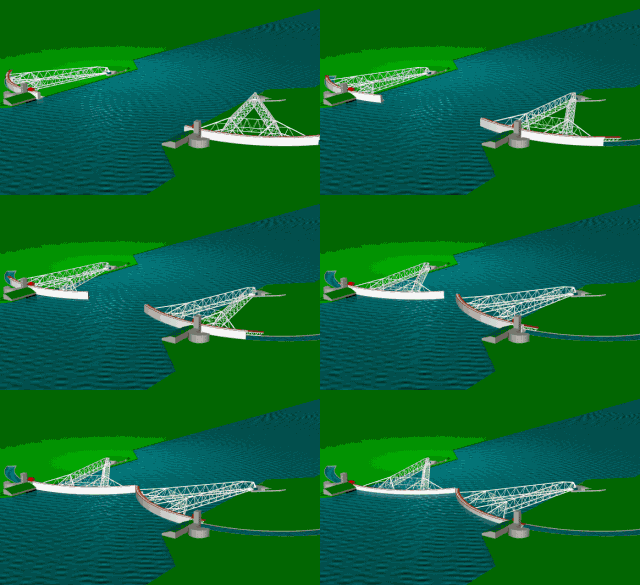
Fig. 2. Closing the
barrier.
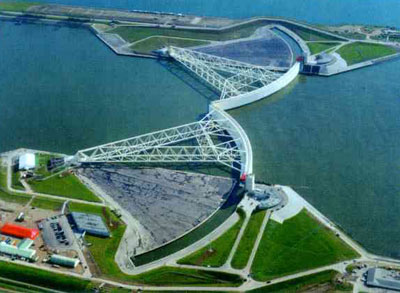
Fig. 3. Closed barrier.
Assignment:
In this project we will develop a control system for the storm surge barrier. This
control systems needs to be based on measurements of water levels and
predictions of river flows and sea water levels, especially as closing the barrier requires a procedure
that takes up to 8 hours. Constraints on maximum allowed water levels
are present. In addition, the model that needs
to be used is characterized by continuous variables, such as water
levels and flows, and discrete actions, in this case, the moment at
which the barrier needs to close. Hence, an appropriate control
methodology therefore seems to be hybrid model predictive
control. In this project this hypothesis will be tested by designing
such a controller for the Maeslant Barrier.
It is expected that the results of this research on hybrid model
predictive control applied
to water systems can be extrapolated to other water systems, such as
the usage of large pumps that can only be turned completely on or
completely off and the timing of putting inundation areas into
operation during high river flows. All in all, the research will
contribute to an increased safety of low-lying countries, such as The
Netherlands.
If you are interested in selecting this project as your MSc project,
please stop by at the office of Rudy Negenborn, Tamas Keviczky, or Bart De Schutter.